
No Peaking
Thirty years later, I'm not sure we didn't

A substantial art installation was unveiled on the campus of my alma mater at the end of my freshman year, way the hell back in May of 1996. Egads, how was that 30 years ago?
Created by Allan Cottrill, “The Ascent of Humanity” sculpture consists of fifteen human figures in bonded bronze. The figures, eight to ten feet tall each, ascend the corner of the Duda World Culture Building at California University of Pennsylvania.
As a history major, I spent a lot of time in that four story (as I recall) building. WCU had been built in the 1960s, when campus architects apparently found windows passe, opting instead for a more Shawshankian penitentiary aesthetic. The sculpture added a little pizazz to the first building visitors saw upon entering campus via the main thoroughfare.
Ascent tells the story of human evolution, starting with Cro-Magnon man at the bottom and continuing upwards through figures representing various races and cultures of the world.
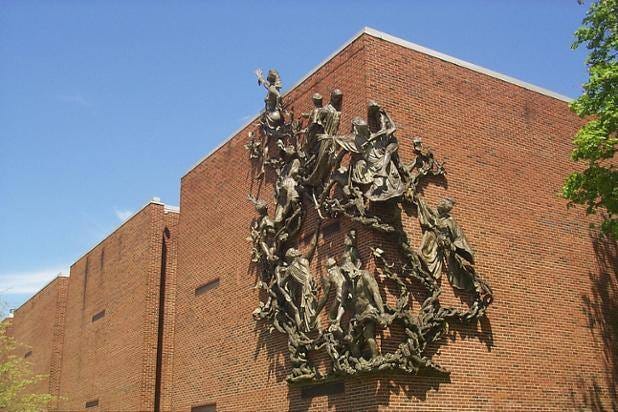
The bronze figures culminate with a female astronaut extending beyond the building’s apex. She reaches for the heavens as a symbol of our never-ending quest to ascend higher.
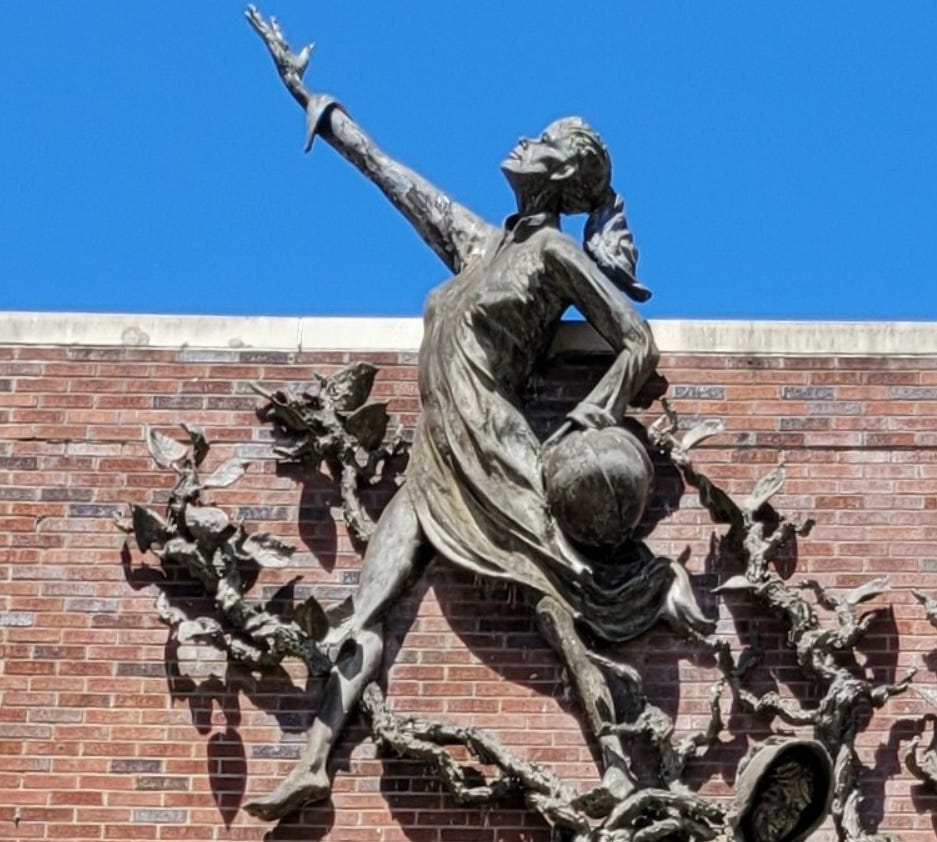
I was just a stupid kid back then, as Alkaline Trio sang in one of my college anthems. You could probably count on one hand the number of worthwhile thoughts I had before the 21st century. But I spent a lot of time thinking about that formidable sculpture.
Female astronauts were already historical reality. Valentina Tereshkova spent three days in space twenty years before Sally Ride’s 1983 voyage. Had we peaked as a civilization before I was old enough to legally have a drink?
I hadn’t thought about these memories in years, but they came back to me during my third viewing of Project Hail Mary, easily one of my favorite books/movies of this disappointing decade.
Sitting in the theater, I recalled how I used to look at the bronze woman as I dragged my skinny frame into WCU for another class. “Guess we already peaked, so what’s the point har har har…”
Well?
I’m starting to wonder if maybe we did peak around thirty years ago.
By 1996, the World Wide Web—placed fully into the public domain in 1993—was experiencing a massive commercial explosion. Within a decade, the revolution had bred smartphones and social media. Sure, it was a fun run for a while there in the early 2000s, but look at what all that got us.
Here we are in 2026, and it sure feels like we are racing backwards. We’ve never possessed more information to know better or had fewer excuses to be terrible. Yet in just the past year we’ve seen assaults on education, equality, and peace. Worse still, tens of millions of people seem okay with our devolution. Thinking critically and accepting objective truth have gone the way of human connection as ignorance and cruelty are celebrated.
And now here comes artificial intelligence to ramp up the speed of everything. It took a generation for us to watch the promise of the internet morph into something ominous. AI has only needed a couple of years to flash its fangs.
Modern observers compare our current AI moment as comparable to where we were with the World Wide Web circa 1996. Back then, we milled around campuses and public spaces without the internet stuffed in our pockets, gloriously uninformed about every single thing.
I haven’t been back to Cal U in years. Long enough, it turns out, that I didn’t realize the Duda World Culture Building had been demolished in 2007. The building I spent seven years hauling myself into, the one I’d measured my own smallness against, is gone.
But the sculpture remains. When they demolished the building, they left the original corner of the exterior standing, a meaningful seam at the intersection of yesteryear and today.
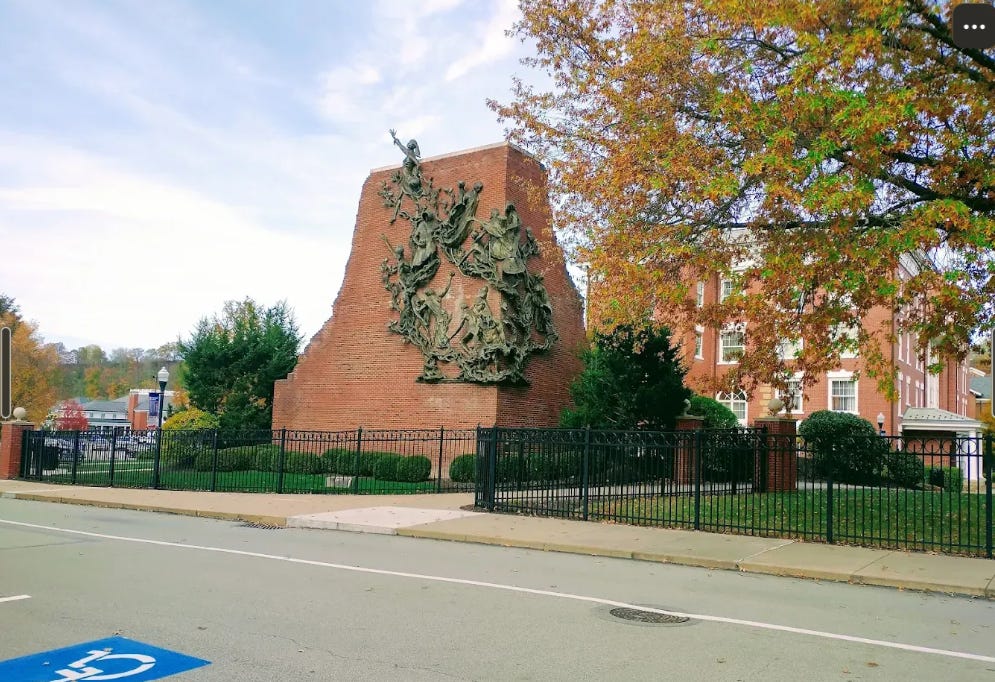
The astronaut never moved. She’s still striving on the same stone three decades later. I find that either deeply comforting or faintly absurd, depending on the day.
The historians I most admire are the ones who resist the seduction of the golden age, the idea that some prior moment was the good version of things we’ve since squandered. I've spent years dismissing ‘good old days’ nostalgia, the hazy fondness papering over Jim Crow, rampant polio, and women who couldn’t open a bank account without a husband’s signature, not to mention the absence of creature comforts like air conditioning and more.
Nostalgia is what happens when memory edits out the parts that didn’t serve the feeling.
But I’m getting older. Cynicism is becoming my resting state in a way it never used to be. As I watch a country I still want to love celebrating ignorance as authenticity and choosing cruelty as policy, I wonder if maybe I was wrong, not about the past, but about the future.
Because yes, we will find new frontiers. The science is real. The possibilities are endless. A treatment discovered through AI-assisted research will save someone’s life next year, and that will be genuinely extraordinary. Artemis II already proved that a mission driven by science and international cooperation can still stir something collective in us. We’ll send humans deeper into space, and explorers will learn life altering lessons for humanity in that undiscovered country.
And yet…
We are more connected than any humans in history have ever been, and somehow less able to reach each other. The monoculture had real costs, but at least we were all, occasionally, watching the same thing and arguing about it together. I don’t know what to do with a world where we each live inside a personalized information universe, convinced that ours is the real one. The internet age was supposed to be the astronaut on the building. I’m not sure what it turned out to be.
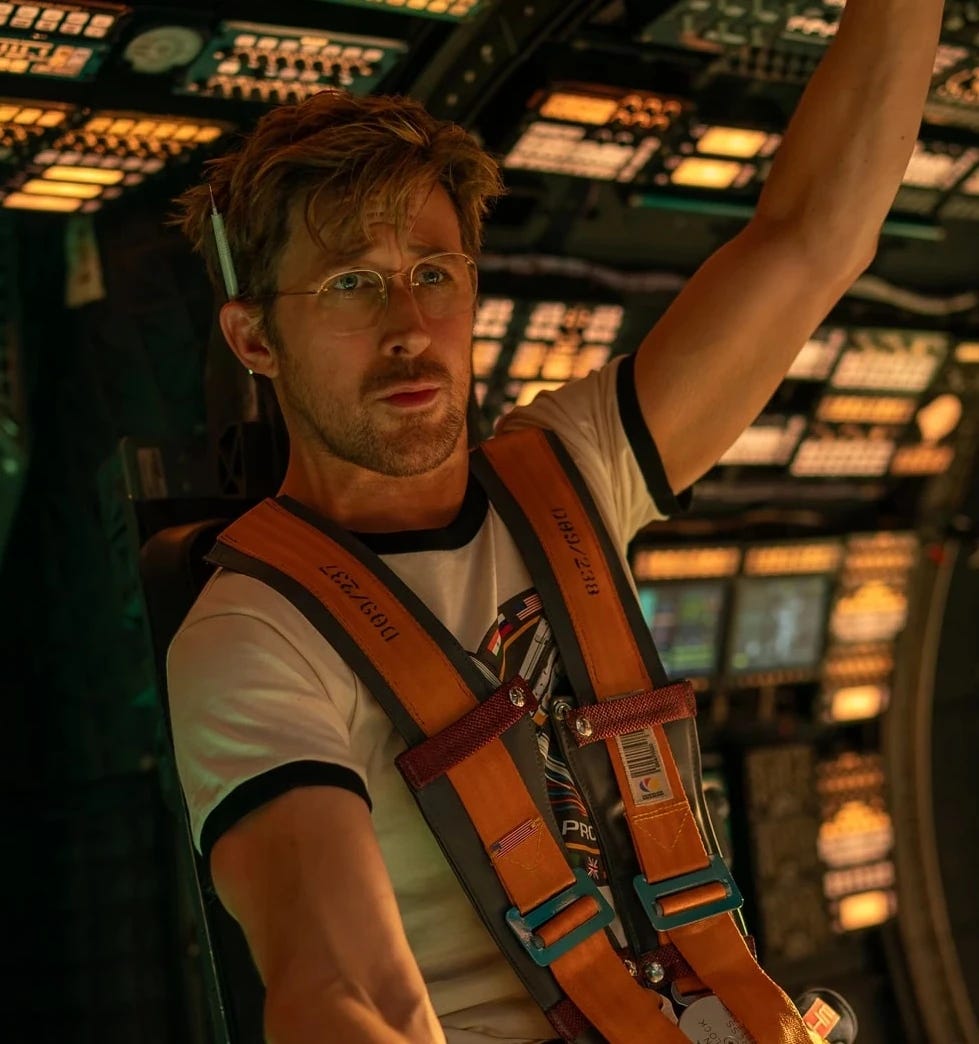
Project Hail Mary got me because it’s about a man who wakes up without knowing how he got there or how long he’s been gone. He has to reconstruct everything from evidence, figure out where he is, what happened, what’s left. He must find a reason to keep going.
I’m not the only one struggling these days, trying to piece together where things stand. The structure I remember is gone. The figure striving remains. She’s still reaching for something we haven’t named yet, on a foundation that will also, eventually, come down.
Blast From The Past

The other night I was on LinkedIn, because I am a party animal, when the site began suggesting people who I may know based on having attended the same college at some point since the Late Pleistocene period.
I understand how you feel, because I feel that way, too. We seem to be devolving, moving closer to our relatives, chimpanzees.